

Walk into most baby shops in Kathmandu or scroll through Instagram, and you will find products. Hundreds of them. What you will not find is anyone who has evaluated them against what a three-month-old actually needs, what materials are safe to put in a baby’s mouth, or which seller verified that what they received is what they ordered.
This guide is structured by age and developmental stage because that is how babies actually use toys. It also covers what to check before buying, because in Nepal’s current market, the sourcing question matters as much as the product question.
How to choose baby toys in Nepal
Three things narrow the field quickly.
Age appropriateness. A toy designed for a 12-month-old is not just useless to a newborn. It can be dangerous. Toys marketed broadly as “suitable for all ages” are a warning sign, not a feature.
Material safety. BPA-free, CE-certified, and FDA-approved are the labels to look for. The problem is that many parents told us they can identify those labels but have no way to verify them on products bought through Facebook pages or Instagram shops. One parent described spending significant time researching a teether online, only to be told it met all certifications by a seller operating with zero platform verification. That gap is real.
Where you buy. Social media platforms allow anyone to create a business page and start selling without proving legitimacy. A staggering 30% of online baby products are estimated to be counterfeit globally. In Nepal, that number may be higher in informal channels. The platform does not check. Positive reviews in the comments do not either.
Best toys for 0 to 3 months
A newborn cannot reach for objects, hold anything, or track movement predictably. But development is happening fast, and the right stimulation matters.
At this stage, babies see contrast far more clearly than colour. Their visual system is tuned to detect edges and boundaries. High-contrast black and white toys sit within a newborn’s 20-30cm focal range and give their eyes something to actually work with.
- High-contrast black and white cards or hanging toys. Simple geometric patterns, not complex illustrations.
- Soft rattles. Lightweight, no loose parts, nothing that requires a grip that has not developed yet.
- Play mats with overhead arches. Dangling objects just within visual range give developing eyes something to track.
Price range: basic rattles and soft toys start at NPR 300-500. A decent activity mat with an arch runs NPR 1,200-2,000.
Skip anything with small detachable pieces, or anything labelled “from birth to 36 months” that involves fine motor skills.
Best toys for 3 to 6 months
At three months, something changes. Babies start reaching. They grasp. They put everything in their mouths, immediately and without exception.
This is when teething toys become relevant, even before the first tooth arrives. Gum discomfort starts earlier than most parents expect. A soft silicone teether, BPA-free and sized so it cannot be swallowed, is one of the most-used items in this window.
- Rattles with easy-grip handles. Not too heavy. Handles shaped so a small fist can actually hold them.
- Silicone teething toys. Soft, BPA-free, and textured so they provide real relief rather than just something to chew.
- Soft fabric books with simple high-contrast patterns. Crinkle textures add sensory variety.
- Sensory balls with different surface textures. These support the tactile development happening rapidly at this stage.
Price range: good silicone teethers range NPR 400-900. Fabric books around NPR 600-1,200.
KuddleKubs’ rattles range and musical and sensory toys cover this age group. The sensory options there are specifically chosen for the mouthing and grasping reflex that defines this stage.
Best toys for 6 to 9 months
Sitting. Reaching. Object permanence starting to click. This is when play becomes interactive rather than reactive.
A baby who can sit with support can now manipulate an object in front of them. They begin to understand that things exist when they cannot see them. Peek-a-boo is not just entertainment at this age. It is a workout for a cognitive skill that is genuinely new.
- Stacking rings. Start with 3-4 rings maximum. The point is not to stack them correctly. The point is cause-and-effect learning from knocking them down and picking them up.
- Activity cubes with buttons, mirrors, and textures. Budget for NPR 1,500-2,500 for one that does not fall apart quickly.
- Musical toys with simple, single sounds. One Kathmandu mum told us she returned a “musical learning toy” because it produced eight simultaneous sounds at high volume. Infant hearing is sensitive. Simple is better.
- Crawling incentive toys. A toy placed slightly out of reach is one of the best motivators for early mobility.
Price range: stacking rings from NPR 500-1,000. Activity cubes NPR 1,500-3,000.
Best toys for 9 to 12 months
Standing. Cruising along furniture. First recognisable words. The developmental window between nine and twelve months is one of the most compressed in a baby’s first year.
Toys at this stage need to support movement and early language. They also need to survive being thrown. Repeatedly.
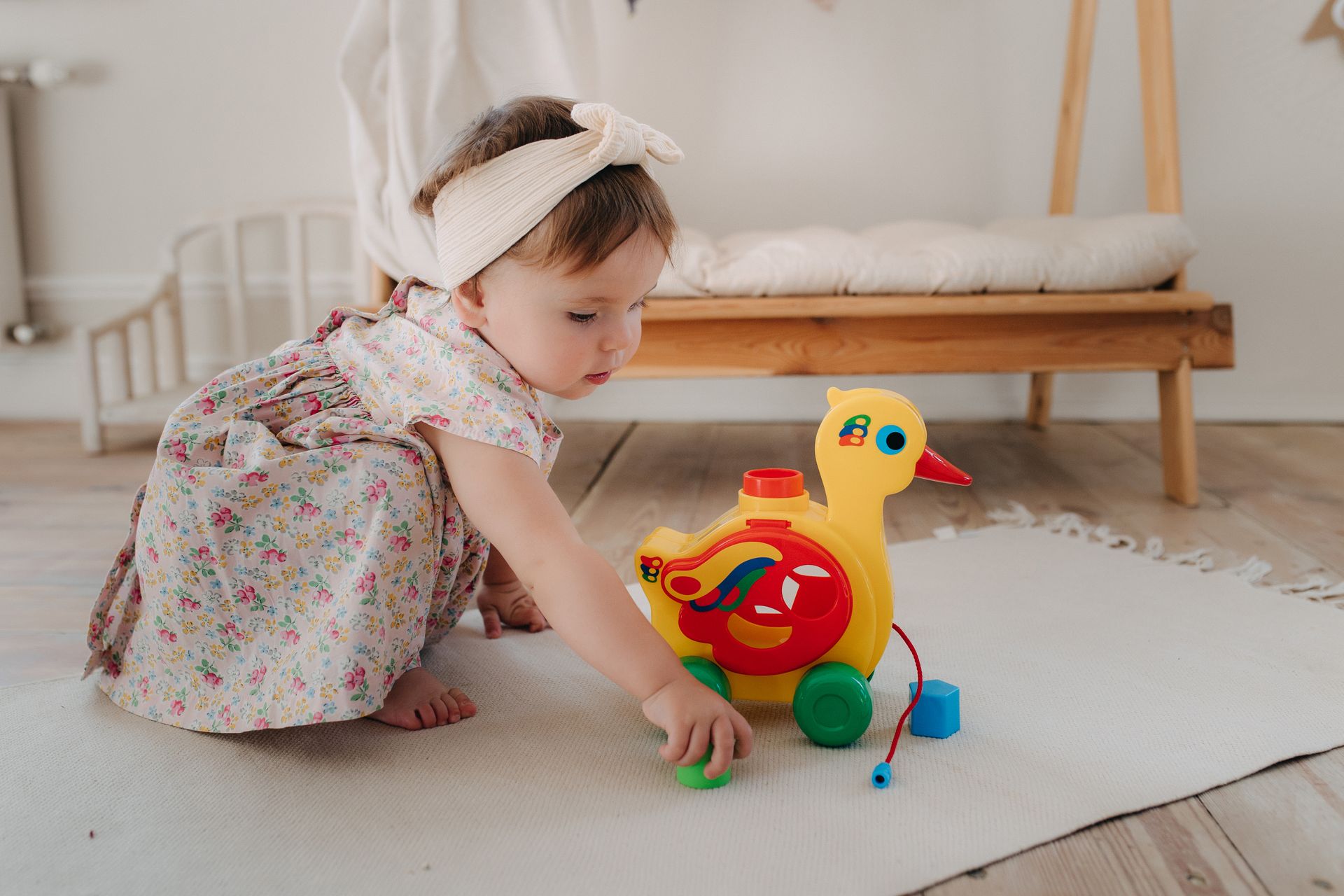
- Shape sorters. Not the eight-shape version with tiny pieces. Start with three or four basic shapes. The skill being built is spatial reasoning, not memorising shapes.
- Push toys for cruising. A solid push toy with a handle at the right height supports the pre-walking movement pattern babies develop when pulling up to stand.
- Simple stacking blocks. Foam or soft plastic. Large enough to stack and knock down without frustration.
- Bath toys. Bath time is play time at this age. Cups that pour, squeeze toys, floating objects.
Price range: shape sorters NPR 600-1,500. Push toys NPR 1,200-2,500.
The educational and learning toys section at KuddleKubs includes shape sorters and activity toys verified for this age range, across fourteen options at different price points.
Best toys for 12 to 18 months
Walking begins. Somewhere in this window, most babies take their first unassisted steps, then spend the following months refining that skill obsessively.
Imaginative play also begins here. A toy phone gets held up to an ear. A toy cup gets offered to a parent. Around 58-60% of Nepali parents now say they prioritise toys that build skills. At 12-18 months, imaginative play is skill-building, not just entertainment.
- Push and pull walkers. At this stage, a walker with activities on the front supports standing play as well as movement.
- Simple wooden puzzles. Three to four pieces, chunky knobs. The goal is hand-eye coordination and the satisfaction of placing something correctly.
- Role play items. A toy phone, a simple pretend kitchen set, cups and plates. These get used intensively for two years or more.
- Ride-on toys. Low to the ground, no wheels that tip, sized so feet touch the floor.
Price range: wooden puzzles NPR 500-1,500. Ride-ons NPR 1,500-4,000. Quality wooden sets NPR 2,500-6,000.
The baby activity and playtime toys section covers this transition period well. If you want to browse by type rather than stage, the full toys category has the complete range.
Safety guide: what to check before buying baby toys in Nepal
Nepal’s baby product market has a trust problem. That is not alarmist. It is what parents report when they describe their buying experience.
One Facebook buyer reported paying double the market price for a product that had gone out of stock at verified retailers. Price inconsistency is one signal worth watching. Another is the seller account itself: how long has it existed, does it have a physical address, is there a return policy stated anywhere. Social media pages can be created and deleted quickly.
The risks from unsafe products are not abstract. Documented outcomes from unverified baby products include skin rashes, digestive problems from materials that leach chemicals, choking incidents from parts that separate, and falls from toys that are structurally unstable.
- Look for BPA-free labelling on any toy that will go in a baby’s mouth: teethers, soft toys with plastic components, bath toys.
- CE marking (European conformity) is a meaningful safety signal. EN71 is the European toy safety standard and is widely used as a reference benchmark.
- FDA-approved labelling is relevant for products with food-grade silicone components.
- Age labelling must be accurate and specific. “Suitable from birth” on a toy with small parts is a red flag.
- For physical purchases: inspect the toy before buying. Check for sharp edges, loose parts, and anything that smells strongly of chemicals.
- For online purchases: buy from retailers who have evaluated their stock rather than simply listed it. The difference is between a shop that carries products and one that has checked them.
Most baby shops in Nepal carry products. Very few have evaluated them.
Frequently asked questions
What are the safest baby toys to buy in Nepal?
Look for toys with CE marking or EN71 compliance, BPA-free materials for anything that goes in the mouth, and no small parts for babies under 12 months. Buy from retailers who can tell you where the product comes from and what it has been tested against.
At what age should babies start playing with toys?
From birth, but the toy type matters entirely. Newborns respond to high-contrast visual stimulation and simple sound. Match the toy to the developmental stage, not a general age range on a label.
Where can I buy baby toys online in Nepal?
KuddleKubs ships baby toys across Nepal with an evaluated product range rather than an open catalogue.
Are wooden toys better than plastic toys for babies?
Wooden toys tend to last longer, do not leach BPA, and hold up better to rough use. The trade-off is weight and edge safety on lower-quality wooden items. The material matters less than the sourcing.
What toys are best for newborns?
High-contrast black and white visual toys, soft lightweight rattles, and a play mat with an overhead arch. Keep it simple.
How do I know if a baby toy is BPA-free?
Check the labelling on the product itself and on the packaging. BPA-free should be explicitly stated. If it is not stated, do not assume it is certified.
